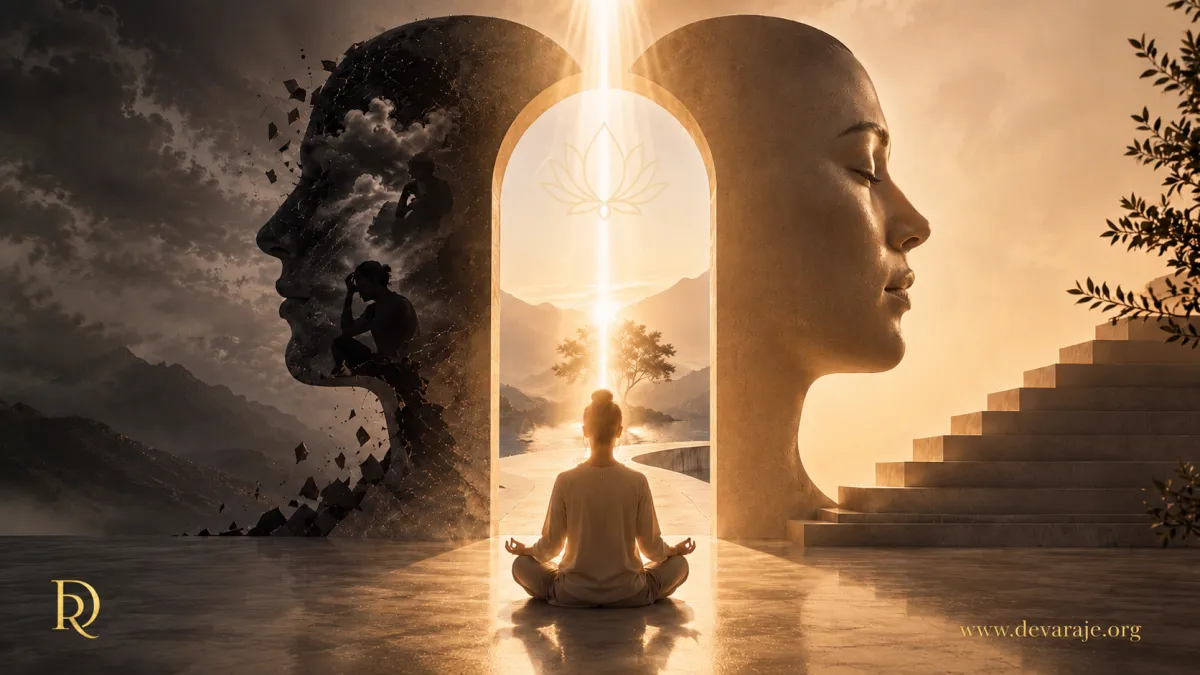
Why Choose Counselling and Psychotherapy with a Spiritual Orientation?
Understanding your mind isn't the same as being free of it.
My work lives in the space between them.
Key Takeaways
Therapy is genuinely valuable: it helps you understand your patterns, regulate your nervous system, and create space between what happens and how you respond.
The real question isn't whether therapy works. It's why understanding your mind and your conditioning doesn't necessarily alleviate inner fragmentation or result in more peace and fulfilment.
Yoga philosophy points to states in which the constant activity of the mind quiets, and you are no longer fully identified with every passing thought and feeling.
Kabbalah teaches that much of our suffering comes from a constant movement toward what we can receive for ourselves. It points to a shift in that orientation, from receiving toward bestowal, which connects us to something greater.
Counselling with a spiritual orientation doesn't ask you to bypass your psychological work. It asks you to meet it fully and let it open into the beyond.
Most people come to me after they've already invested serious time in therapy. They understand their attachment patterns. They can name their trauma responses, their protective parts, the conditioning that shaped them.
That work matters, and it's real. But at some point, a different question starts to surface: why doesn't understanding my mind and my conditioning alleviate my pain? And why doesn't all this internal, reflective work bring the inner peace and fulfilment I deeply crave?
That question is the reason why I bring two established spiritual sciences, Yoga and Kabbalah, into the work, while grounding the process in psychological and therapeutic practices as well.
It's worth distinguishing the two terms here. Pain is the direct, often unavoidable experience of loss, disappointment or difficulty, the natural response to what happens to us. Suffering is what tends to form on top of it: the resistance, the story, the identification the mind adds, which is often what actually keeps a person stuck long after the original pain has passed.
What Psychology and Therapy Do Well, and Where They Are Limited
Through therapeutic work, we come to understand our attachment patterns, our trauma, our nervous-system responses, and the survival strategies we built to get through what we couldn't otherwise handle. We start to see why certain relationships trigger us, why the same dynamic repeats, and how to create space between what happens and how we react, so we can respond instead.
One of the central modalities I use is Internal Family Systems, developed by psychotherapist Richard Schwartz. It sees the mind not as one fixed self, but as made up of parts, each formed to protect us at some point, each carrying its own fear, role, and strategy: for instance, a part that shuts down to avoid conflict and the fear of not being loved, or a part that people-pleases, hiding inadequacy to avoid rejection. Examining these parts offers a deeper lens into what activates us, and the very lens through which we meet and shape our reality.
Protective adaptations were once survival mechanisms which, at present, create friction and disconnection long after the original danger has passed. This work invites us to meet ourselves with curiosity rather than judgment, cultivating the coherence and self-knowledge from which real change and freedom follow.
This is where we can truly begin the real movement toward a liberated state: the space between activated, reactive parts and what Yoga calls our True Self - an unchanging awareness beneath every thought, emotion, and identity we take ourselves to be, which is in complete fullness. Once revealed, it no longer identifies with mind or body, resting instead in a consistent state of peace and wholeness, a state, Kabbalists teach, creation was made to bestow.

Why Yoga Philosophy Enters the Picture
Yoga philosophy has spent thousands of years studying something psychology rarely asks. Not just how the mind functions, but the deeper nature of consciousness, and our relationship to suffering, desire, and attachment.
One of its central ideas is Samadhi, from the Sanskrit meaning "union" or "complete absorption." A state in which the constant activity of the mind subsides, and a person is no longer identified with whatever thought, emotion, or sensation moves through them. Not better thought management. A direct experience of awareness itself.
Desire keeps the mind in constant motion. The entire aim of yoga is to quiet that motion, not to master the physical poses so heavily marketed. Patanjali, the ancient sage who compiled the Yoga Sutras - the foundational text of classical Yoga philosophy- names five root afflictions that keep the mind bound to suffering: ignorance, ego, attachment, aversion, and fear of death. The pull toward pleasure that keeps us reaching rather than resting is also what Kabbalah points to.
A free 15-minute call to find out whether this integrative approach is what you are ready for. Click Here To Schedule
What Kabbalah Actually Teaches About Desire
Kabbalah offers an unusually complete framework for understanding the deeper principles behind human desire, perception, and suffering.
One of its central teachings, not too dissimilar to the yogic perspective, is this: much of our suffering comes from experiencing life primarily through a single, constant movement: what can I receive for myself? Am I getting what I need? Am I safe, loved, recognised? Am I losing something? This is not only a survival adaptation of the mind but our soul’s desire to receive the ultimate, which is the endless light. According to Kabbalah, this points to something more fundamental: the desire to receive is the very essence of our existence. In fact, we are a vessel- made entirely of the desire to receive.
Kabbalah describes an extraordinary possibility: a gradual shift into our truest nature, brought about by altering our relationship to desire itself, from a desire oriented solely toward receiving for the self (ego), to a desire that receives in order to give, to participate in, and connect with, something greater than the self.
Rav Yehuda Ashlag, one of the foremost Kabbalists of the twentieth century, describes this movement as the transition in the orientation towards life where becoming like the Creator or in equivalence of form with the boundless force of goodness returns us to wholeness and fulfillment. Kabbalah teaches that the infinite light is concealed, and it's through our own effort to reveal it that we come to earn, and therefore delight in, when received.
This orientation changes everything: how a person moves through conflict, disappointment, and relationship, and, in time, becomes the very channel of bestowal, which is the purpose of creation.
The therapeutic work of mapping our parts, understanding the reactive patterns and behaviours that arise from these unintegrated aspects of the fragmented self, cultivates the space between reactivity and the desire beneath it. It is within this space that a vessel is formed. The agony of feeling the lack and the yearning to be complete and practice this inner orientation attracts ‘the light that reforms’-האור המחזיר למוטב.
No measure of psychological work alone, not even three decades of it in my personal experience, has brought a person to the depth of peace and stillness that only this light restores when the work is genuine. The self-reflection with the mind, however rigorous, is but a preparation, a threshold that opens onto an intelligence far greater and a repair far more complete than the ego self can achieve alone.

What It Means to Have Counselling With a Spiritual Orientation
Psychology and therapy work within the human condition. They help you understand the mind, the body, trauma, attachment, and the ways you learned to survive. This can bring enormous relief, coherence and freedom, and that matters deeply, but once again not many people find this to give them a sense of absolute peace.
On the other hand, leaping over unresolved psychophysical adaptations and straight into spiritual practice as we’ve seen in recent decades, isn’t complete either and often produces what's known as spiritual bypassing. John Welwood coined the term to describe how spiritual beliefs and practices can be used to avoid facing unresolved emotional wounds and unfinished developmental work. Robert Augustus Masters later expanded on this, showing how it can look like forced positivity, emotional detachment, or a premature sense of transcendence that leaves maladaptations untouched.
We need both.
Without a spiritual orientation, we stay within the realm of mind and body forever without moving toward where our true human potential really lies. Spiritual work points beyond the human condition itself. Ancient traditions describe a state of being no longer governed by fear, craving, resistance, and identification. Not simply calmer or more regulated, but fundamentally different: whole, complete, deeply fulfilled, and in harmony with reality rather than in a quiet negotiation with it.
There are sevrals discriptions caommonly knows for this extraordinary possibility: Liberation, awakening, a state of unity, self-realisation, enlightenment. The word matters less than meeting the human condition fully and honestly, then asking what might exist beyond it. Not simply coping better with suffering but investigating whether the very structure that produces suffering can loosen its grip at all.
If the inner work has been genuine, and a gap remains between where you stand and the state of being you sense is possible for you, a free 30-minute call is a chance to explore whether mentorship is the right next step. Click Here To Schedule